Let’s talk about cholesterol shall we? How about coconut oil and cholesterol? Come on…don’t be scared. Despite what you have been brainwashed into thinking, cholesterol is your friend not your enemy. It’s really very good stuff!
Many people believe that cholesterol is some sort of saturated fat since it is mentioned casually alongside saturated fats in conversation. In fact, cholesterol is not a fat at all. It is this cool waxy substance created IN our bodies from small molecules of acetate that result mainly from the breakdown of fats and sugars and sometimes proteins. Most people get cholesterol from eating animal products. You aren’t ever going to find it in plant foods.
Cholesterol certainly have been demonized over the years. There is a reason for that and it has to do with big pharma and our government but I’m going to bite my tongue and not go all conspiracy theory on you here. (But man I love a good one!)
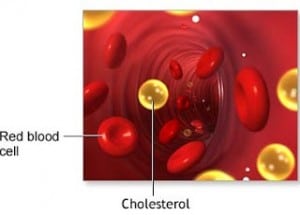
Healthy individuals produce the cholesterol they need for their bodies to function.
Cholesterol is ESSENTIAL for helping cell membranes retain their structural consistency. The membranes’ fluidity is in a constant state of flux relative to the types of fatty acids present in the body. Unsaturated fatty acids make the membrane cells rather soft and fluid. Saturated fats make the membranes more rigid. Cholesterol flows in and out of the cell membranes creating the perfect balance to keep the membranes in peak shape during changing conditions.
This balance is so critical that each cell actually has the ability to produce its own cholesterol. So, if cholesterol is sooooo bad for you, why does each and every cell have the ability to produce it? Doesn’t add up does it?
Cholesterol plays a lot of other important roles as well. Check out just a few of these pretty cool abilities. It:
- Plays a role in healing damaged tissue
- Works alongside collagen and calcium to form scar tissue
- Is a building block for vitamin D
- Is a building block for hormones that regulate sexual functioning (think estrogen, progesterone, and testosterone)
- Makes stress hormones – the kind that prepare us for flight or fight
- Maintains the health of the intestinal walls
Obviously we do not want our bodies devoid of cholesterol. But why all the fuss over it?
It all comes down to lipoproteins.
Remember how I referred to it as a cool waxy substance? Well, that wax is actually a coating of a compound called a lipoprotein. This makes it water soluble so that it can cruise around in the bloodstream with ease.
Lipoproteins are described in terms of their density. High-Density Lipoproteins (HDL) carry cholesterol away from the cells to the liver so it can be eliminated from the body if it is not needed. Low-Density Lipoproteins carry cholesterol to the cell walls so that they can repair damage. HDL is known as the good cholesterol. LDL is known as the bad cholesterol. But good or bad, they both play an important role. It is really more important to look at the RATIO of HDL to LDL. Technically speaking, you are in a favorable position if your HDL levels are higher than your LDL levels.
Coconut Oil and Cholesterol
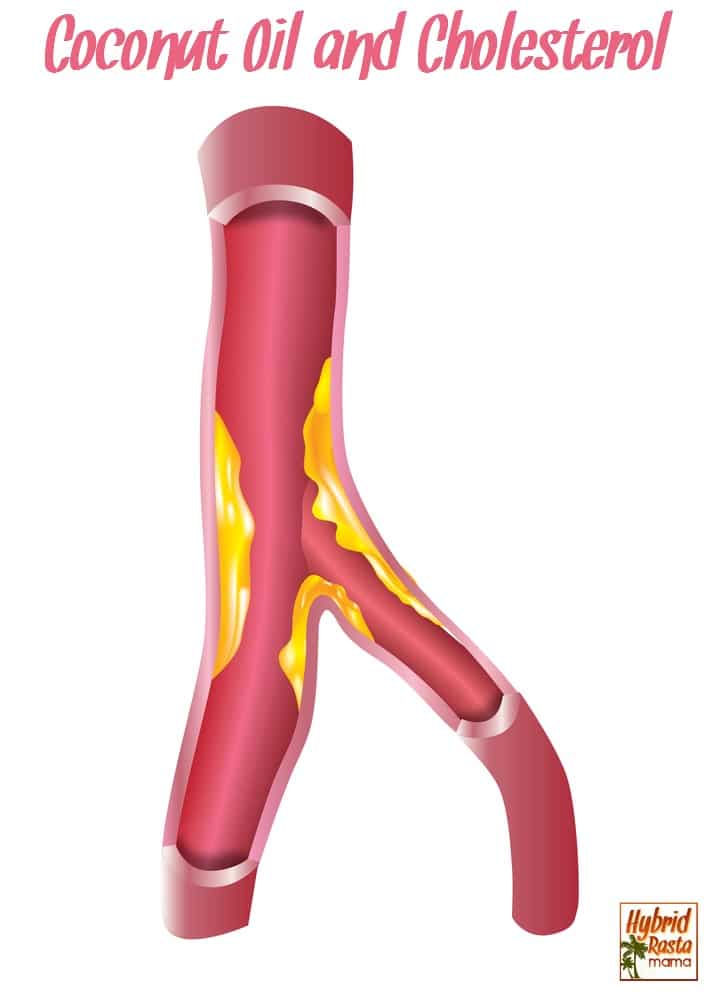
Coconut Oil is known for raising the HDL levels of cholesterol thereby creating a favorable HDL to LDL ratio. And yes, it does have a high saturated fatty acid content but the saturates in unrefined virgin coconut oil are plant based and are composed of medium-chain fatty acids.
Medium-chain fatty acids found in coconut oil are rapidly absorbed then carried by the portal vein to the liver and converted into immediate energy, which means they are not stored as fat (like long chain fatty acids are). The medium-chain fatty acids are easily metabolized and do not require lipoproteins or special enzymes in order to be effectively utilized by the body. There is absolutely no danger of the medium-chain fatty acids being stored in the arteries.
So basically, what that all means is that coconut oil will NOT raise LDL levels and instead will create a better HDL to LDL balance.
In case you are interested, the real culprits of raising LDL levels are:
- Refined vegetable oils that are inflamed inside the body
- Sedentary lifestyle
- Smoking
- Stress
- Too much carbohydrates
- Too much sugar
- Trans-fatty acids from hydrogenated oils
Still confused, floundering a bit? I know, this IS all very confusing which is why there is so many poorly informed people out there! But what it all boils down to is that coconut oil will likely have a positive effect on your cholesterol.
Want to know where I purchase my coconut oil? Check out which coconut oil I use and love.
Sources for this article include:

FabulousMamaChronicles says
Mmm…coconut cholesterol!
Peggy says
I just had my cholesterol and glucose checked as part of a health fair where I work. The one doing the testing was amazed at my test results. After we went through everything we met with a nurse practitioner. She just kept going on that she had never seen such great cholesterol numbers. In our discussion I mentioned that I put coconut oil in my smoothies daily. She said, “Ah! Coconut oil, that explains it all then.” In comparing with my numbers from 14 months ago, it’s like results from two different people. I’m amazed!
Krissy says
I have high cholesterol in my family and ever since adding in coconut oil, grass fed butter and other naturally occurring saturated fats my results are virtually normal. I say virtually because the triglycerides (the really bad ones) were the lowest my doc had ever seen. My bad cholesterol was higher than recommended, but my good cholesterol was well above good and somewhere along the line of “stellar”. I got a speech about how saturated fats were bad hence my higher number however I was ecstatic and I was going for the ratio you mention. It actually works.
Trish says
I was wondering how much coconut oil to take a day? I have high LDL that is not hereditary. I just eat like crap. My GP even sent my to a cardiologist because it is so high and I am young. I am trying to eat better but would love to take coconut oil to help bring my LDL down. The cardiologist didn’t put me on statins as he said I can bring it down with diet and exercise. Thank you!
Jennifer says
Hi Trish! Well, coconut oil won’t completely save the day if your entire diet is poor. But it might help. I would start with one teaspoon and gradually work up from there. I personally take about 4 tablespoons per day. The key is to just increase slowly, giving our body time to adjust. Wait about 3 days between increases. Good luck!
Jean-Pierre says
Im french and im very glad to read your health blog. Coconut is very good for stress and for skin too.