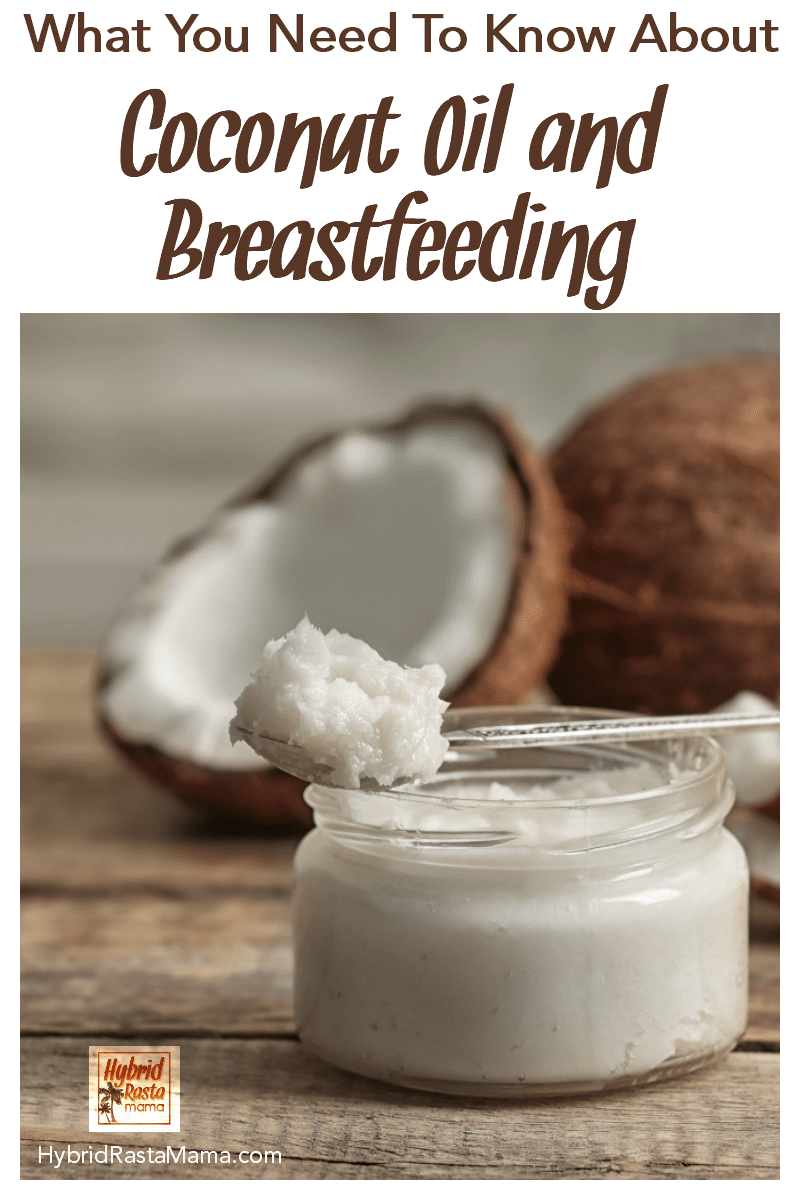
What a lovely set of coconuts!
Stop for a second and give that some thought. I know I am not the only person who honestly sees the similarities between coconuts and breasts. I mean, seriously.
Coconuts.
Breasts.
Coconuts.
Breasts.
Same general shape. Come in all sizes. Produce milk.
There is a reason the coconut and the breast are so similar! Both contain life-giving properties for nursing mothers and their babies!
Coconut Oil For Breastfeeding
The unique composition of human breast milk contains about 45% to 50% saturated fat, about 35% monounsaturated fat, and 15-20% polyunsaturated fat. An important component of breast milk is medium-chain fatty acids (MCFA). The MCFA, lauric acid, caprylic acid, and capric acid, comprise about 20% of total saturated fatty acids found in breast milk.
Fun fact: Lauric acid is the most plentiful MCFA found in breast milk AND coconut oil. And the ratio of lauric acid to other MCFAs in human milk is IDENTICAL to that in coconut oil.
Quick disclaimer – I am required to clearly state that I am not a licensed medical professional nor do I pretend to be one on this site. Take what I write as a launching off point to do your own research. My advice, experience, and suggestions are not to be considered medical advice.
The MCFAs in coconut oil improve the absorption of nutrients already existing in the mother’s diet. The MCFA enables the absorption of minerals, magnesium and calcium, some of the B vitamins, the fat soluble vitamins like A, D, E, K and beta carotene, and some amino acids. Pancreatic enzymes aren’t even necessary to digest them. These nutrients are of course passed onto the nursing infant through the breast milk.
For these reasons, it is important that a mother’s breast milk contain as much medium chain fatty acids as possible.
According to research, when a lactating woman adds foods rich in lauric acid to her diet, the amount of lauric acid available in her breast milk increases substantially to levels three times the original level and nearly double the amount of capric acid. A single meal with coconut oil can significantly affect the breast milk fatty acid compositions for 1 to 3 days with the maximum increase occurring during the first 10 hours.
To further support this, in The Coconut Oil Miracle, author Bruce Fife states that “when nursing mothers eat coconut products (more specifically coconut oil) the levels of the MCFAs in their milk increase significantly. For instance, eating 40 grams (3 tablespoons) of coconut oil in one meal can temporarily increase the lauric acid in the milk of a nursing mother from 3.9 percent to 9.6 percent after 14 hours. If the mother consumes coconut oil every day, the MCFA content will be even greater.”
Another very important function of MCFAs is that they protect the baby from harmful microorganisms. This is especially critical for a premature or special needs baby.
Infants’ immune systems are immature and incapable of adequately defending themselves. The infant’s immune system is heavily supported by the antibacterial, anti-viral, anti-fungal, and anti-parasitic properties of these vital MCFAs in coconut oil. In fact, without these unique saturated fats, an infant would probably not survive long. It would become malnourished and highly susceptible to a myriad of infectious diseases. This is why MCFAs are added into all baby formula on the market. Unfortunately, the MCFAs in formula are inferior to the MCFAs found in breast milk.
Coconut oil does not just benefit a breastfeeding infant or child.
The MCFAs in coconut oil also help to regulate blood sugar levels in the mother while providing her with a stable source of energy. Since MCFAs are not stored and instead are burned off in the form of energy, this will only help a new mother to continue losing any unneeded extra baby weight. And as mentioned before, they will help the mother more effectively absorb the nutrients her body needs.
If you are planning on becoming pregnant or already pregnant, get a head start on creating a rich supply of breast milk by adding it into your daily diet! Pregnant females store fat to assure successful lactation. Any lauric acid and capric acid in the diet becomes part of the adipose fat stores. The milk fat of a lactating mother is made up of these stores as well as her current diet. So make sure your fat stores are chalk full of MCFA goodness!
But wait – there is more coconut oil for breastfeeding goodness. In can be found in this post all about nipples and blebs. You also won’t want to miss my post on nipples and lady bits. I tell you – coconut oil for breastfeeding is just the tip of the iceberg here. 😉 That shouldn’t shock anyone seeing that there are so many uses for coconut oil.
Just in case you were wondering, I get my coconut oil here.

Sources for this article include:
Lauren @ Hobo Mama says
I got such a kick out of opening your post and seeing my coconuts! Ha ha ha!
And, boy, am I glad I’m a breastfeeding mama who uses coconut oil now! Thanks for all the info.
mamapoekie says
lovely post! will be using it in sunday surf
Natalie says
This is very interesting.. I’m due with number 2 in June, and struggled with low supply at the start with my firstborn. This time round though, my diet is much improved, and so I’m hoping that overall it will be easier. I’ll definitely try to up the coconut oil intake, I struggle to have it on it’s own, but love to cook with it, and use it in baking! And am slightly obsessed with cacao powder and coconut oil at the moment.. do you know how cacao would affect a newborn..? I refused to believe that my diet would affect my daughter when we were feeding – but thinking I might need to rethink that – I’m sure now that what I ate would’ve been contributing at least a bit to her ‘happy chucker’ status, restlessness and wind.
Allison Ikeler says
I am new to coconut oil. I’ve been reading all the benefits from it and decided to try it. The only kind I found at walmart was organic coconut oil refined (which i bought), and virgin coconut oil. I thought organic was better… It seems really thick and dry…..
Jennifer Saleem says
@Allison Ikeler Unrefined (virgin)coconut oil is the best, no matter what brand. During cool weather, all coconut oil will be thick and dry. When the temperatures hit 80, it will liquify.
George Scaria says
Its true….When Coconut oil is refined,for sure some natural contents are lost.Whether its Virgin or natural Coconut Oil,filtered is fine….Refined will not have all the natural ingredients….
Jennifer Saleem says
@Natalie Every baby is different so it is hard to say how cacao would effect a newborn. It probably won’t have a negative impact unless for some reason your baby is super sensitive to even a hint of caffeine (of which cacao contains very little). I would say try it and see what happens!
Karen says
How much coconut oil should I have a day (or what time span) to promote milk production??
Jennifer says
Time of day/time span does not matter but the more you can get in you the better! 12 tablespoons per day would be ideal but try for at least 6!
Nicole says
How do you eat the tablespoons? I can’t take straight coconut oil off the spoon. Blech!
Jennifer says
Best thing to do is to cook or bake with it. You can also add it to tea, coffee, or a smoothie. Even I have trouble eating it straight sometimes! It does not matter how it gets in. It doesn’t loose any health properties if you cook with it!
Fernanda says
I was told by my doctor to apply coconut oil to my nipples after each feeding… It has helped me a lot, as I don’t have cracked nipples any longer. However, if the baby ingests some of it, would that be a problem?
Jennifer says
Not a problem at all! My daughter got her fair share and it only helped her health overall!
Nicole says
I’ve read some other comments about leaving coconut oil on your nipples before the baby feeds and how it could be a problem due to allergies. Is that a valid concern?
Jennifer says
Well, there certainly is a risk but honestly, you don’t know until you try. If your baby is allergic, YOU eating coconut could pose the same risk. I would simply rub some coconut oil onto your baby and see if there is a skin reaction. If not, rub a wee bit inside her cheek during a time when you could get to a doctor if something goes awry. Chances are slim but this is my best advice is you are concerned. 🙂
Ana says
Can it be taken in directly? Is there a certain amount thats to much?
danielle says
How long will it take for my supply to improve if I do 12 teaspoons aday? Of coconut oil? I’m supplementing now at 3m and would like to pump and nurse and have tryed teas fenugreek milk bars herbs ???? Want to try everything want what’s best for my baby:)
Jennifer says
Hi Danielle! You know, supply depends on a lot. What does your normal day of eating look like? How much water are you consuming? Are you taking other supplements or herbs (because a lot of them can mess with supply). Typically, coconut oil works after a little build up in your system. This time frame varies from person to person. But in my experience, it worked within a week. Tell me more about what you have tried and I will see if I can help more.
Gina says
Is there an alternative that is just as good as coconut oil? I’m allergic to coconut but want to reap the benefits of it.
Kenneshia Phillips says
I’m EBF my 11 week old and would like to add coconut oil to my diet this week. My current concern is my LO seems to be developing eczema on his face only. I’m staying away from any prescription right now, I just feel he is to young for that. My question is, Will the coconut oil have any affect, (positive/ negative) to his eczema?
Aviva says
Coconut oil is fantastic to use on babies. I have a baby with very sensitive skin and it is the only thing I use on him… nappy rash, cradle cap, in his bath and on dry skin. Ive also used it to clear up eczema on myself, as a moisturizer, deodorant, in food…
Yummy says
Use coconut oil instead of butter in your favorite oatmeal cookie recipe for scrumptious lactation cookies!!!!
Stephanie says
Yay, thanks for this – I was wondering how to incorporate coconut oil into my diet. Any other cooking ideas?
Jennifer says
I wrote a post on how to consume coconut oil. Check it out here: https://hybridrastamama.com/how-to-consume-coconut-oil-reader-questions-answered-plus-coconut-oil-candy-recipes
This should get you started!
I also have a book out with all kinds of coconut oil recipes!
http://www.jennifersaleembooks.com/cooking-with-coconut-oil/
Beth says
Such a great idea!
SA says
I would love to see this same study for hemp seed oil. I’ve been taking it everyday since my first trimester- along with coconut oil several times a week- and she’s now nearly 5 months old. I’ve got avocados in there nearly daily since then, too. Hubby says we have a small fortune invested in fat.
Jocelyn says
Thank you for this in depth look into coconut oil and all of its benefits! I am curious to know if there are recipes or cooking methods that are better at retaining all of these great nutrients. Does it even matter how we consume it, cooked, baked, fried, etc?
Jennifer says
Hi Jocelyn! Honestly, any way you can get coconut oil into your body is just fine. If you eat it straight off the spoon, it gets into your system faster but really, it doesn’t matter how you consume it. Just get it in!
Sophia Wheeler says
Yes, I’ve just started eating / adding coconut oil into my diet again. I used to have it with my soup as garnish instead of olive oil. I also add it to smoothies and sometimes I just take it right off the spoon. I am 34 weeks pregnant so I don’t have much longer to go!
I hope to be consistent these next few weeks.
Jennifer says
Congratulations on your new baby! I hope you have a smooth delivery. Any coconut oil you can get in will help your baby. Just do your best. 🙂
Sbacc says
I was thinking if applying it on nipples before feeding in order to make baby consume it will make baby any healthier ? If yes then how soon we can expect result
Jennifer says
Absolutely do this! Coconut oil gets to work instantly…boosts the immune system and helps with overall wellness in a baby. You won’t necessarily “see” it working but it will do its job.
Sbacc says
Thanks !! To be honest I was being greedy to know if it will accelerate weight in my 5 months old DD . In any case I will be using it for mutual good.